

Growth
B2B Marketing in Japan: Everything Foreign Businesses Need to Know | Boostify Japan
Expand your business in Japan with proven B2B strategies. Learn how Japanese buyers build trust and drive growth.

Boostify
July 17, 2026
If your business has been successful in your home market, expanding into Japan has probably crossed your mind more than once.
Perhaps you've received enquiries from Japanese companies, been introduced to potential partners through existing clients, or simply watched competitors establish a presence in one of the world's most respected business markets. Whatever sparked your interest, you're now facing the same question many international business leaders eventually ask themselves:
How do we successfully grow our business in Japan?
It's a question with no simple answer.
Many companies assume that entering Japan is simply a matter of translating their website, attending a trade show, or finding a local distributor. While those things certainly have their place, they don't address the biggest challenge foreign businesses face.
The real challenge isn't entering Japan.
It's earning the trust of Japanese companies.
That's because the way Japanese businesses discover new suppliers, evaluate potential partners, and make purchasing decisions is often very different from what you're used to in North America, Europe, Australia, or other international markets. Strategies that consistently generate customers elsewhere don't always produce the same results here.
The encouraging news is that you don't need to reinvent your business.
If your company has grown because you deliver quality, solve real problems, and build lasting relationships with customers, those strengths are just as valuable in Japan as they are anywhere else. What changes isn't your product or your expertise—it's how you present those strengths to a market that's evaluating you through a different lens.
This guide isn't about company registration, visas, or legal procedures. Instead, it's about what happens after you've decided Japan is your next market.
We'll explore how Japanese B2B buyers research suppliers, what influences their purchasing decisions, how they discover new companies, and the digital marketing strategies that help foreign businesses build credibility and generate sustainable growth.
By the end of this guide, you'll have a much clearer understanding of what it actually takes to build a successful B2B presence in Japan—not just launch one.
Japan has long been one of the world's most attractive destinations for international B2B companies. As one of the world's largest economies and home to globally recognised manufacturers, technology companies, healthcare organisations, financial institutions, and enterprise businesses, it offers opportunities that many foreign companies simply can't ignore.
But market size is only part of the story.
What makes Japan especially attractive is the way many businesses approach partnerships.
Unlike markets where purchasing decisions are often driven primarily by price, Japanese companies tend to place greater value on reliability, consistency, expertise, and long-term relationships. They aren't simply looking for a vendor who can solve today's problem—they're looking for a partner they can depend on for years to come.
If those values already define your business, you're starting from a stronger position than you might think.
However, this is also where many foreign companies make their first mistake.
They assume that because they have an excellent product, international experience, or a well-established reputation in their home country, opportunities in Japan will naturally follow.
Unfortunately, that's rarely how it works.
Japanese buyers can't appreciate strengths they never discover.
Even after someone hears about your business through a referral or an industry event, they'll almost always begin their own research before deciding whether you're worth contacting. They want to understand who you are, what you've accomplished, who you've worked with, and whether your business feels like a safe long-term choice.
The best product doesn't always win. The company buyers trust the most often does.
That's why successful companies entering Japan rarely focus on selling immediately.
Instead, they focus on becoming visible.
They demonstrate expertise through valuable content, establish credibility through customer success stories, and make it easy for potential clients to understand why they're different from every other supplier in the market.
They understand something many businesses overlook.
Trust isn't built when you send your proposal. It's built long before the proposal is ever requested.
Once you begin looking at the Japanese market from that perspective, your entire growth strategy changes.
Your goal is no longer to convince people to buy your product.
Your goal is to make it easy for the right businesses to discover your company, understand your expertise, and feel confident enough to start a conversation.
That's where sustainable growth in Japan begins.
But before you can build that trust, you first need to understand how Japanese companies actually make purchasing decisions.
Before investing in advertising, attending trade shows, or hiring a local sales team, it's worth understanding one of the defining characteristics of Japan's B2B market:
Important purchasing decisions are rarely made quickly.
In many Western markets, a compelling demonstration or strong sales presentation can move a deal forward relatively fast. In Japan, however, purchasing decisions usually involve careful research, internal discussions, multiple stakeholders, and a strong preference for reducing risk before making a commitment.
By the time someone contacts your business, they've often already formed a first impression.
And that impression wasn't shaped by your salesperson.
It was shaped by everything they found online.
Your first sales meeting doesn't begin when you introduce yourself. It begins the moment someone searches for your company on Google.
Think about your own buying behaviour.
If someone recommended a new software platform or consulting firm to you tomorrow, would you sign a contract immediately?
Probably not.
You'd visit their website, compare them with competitors, read customer success stories, explore their LinkedIn profile, and look for proof that they're a company worth trusting.
Japanese buyers do exactly the same thing.
They want evidence.
They want credibility.
Most importantly, they want confidence that choosing your business won't become a mistake six months later.
That's why your digital presence plays such a significant role in the buying process. Every page your prospects visit helps answer questions they may never ask directly.
Have you solved problems like ours before?
Do you understand our industry?
Can your team support us long-term?
Will we feel confident recommending your company internally?
Those questions matter because purchasing decisions in Japan are rarely made by one individual alone. Managers, technical teams, procurement specialists, executives, and finance departments may all evaluate your business from different perspectives before a final decision is made.
Your marketing therefore has a much bigger job than simply generating leads.
It needs to build confidence across an entire organisation.
The companies that succeed understand this.
Rather than relying on aggressive sales tactics, they focus on providing useful information, practical insights, and clear evidence that they're a trustworthy partner.
Long before buyers evaluate your product, they evaluate your company.
And when your online presence consistently answers the questions your prospects are already asking, you've already taken one of the biggest steps toward winning business in Japan.
Imagine you're exhibiting at a trade show in Tokyo.
Throughout the day, you have dozens of conversations with potential customers. Business cards are exchanged, product demonstrations are given, and several companies express genuine interest in learning more.
You leave the event feeling optimistic.
A week later, however, very few of those conversations move forward.
What happened?
In many cases, nothing went wrong during the exhibition itself.
The real evaluation began after everyone went home.
Before replying to your email or scheduling a meeting, your prospects started researching your company. They searched for your business on Google, visited your website, explored your LinkedIn page, looked for customer success stories, and compared your business with several competitors.
During that process, they weren't trying to decide whether your product worked.
They were trying to answer a much more important question:
"Can we trust this company?"
That's why your digital presence has become one of your most valuable business assets.
Long before your sales team introduces your solution, your online presence has already introduced your company.
Think of it as your first sales meeting.
Every page on your website, every article you publish, every customer testimonial, and every case study contributes to the first impression your business makes. If a potential customer can't quickly understand who you are, what problems you solve, or why companies choose to work with you, they'll simply continue their research elsewhere.
One of the biggest misconceptions foreign businesses have is believing that a website exists simply to explain what they do.
For Japanese B2B buyers, it serves a much bigger purpose.
It answers questions they may never ask directly.
Have you worked with businesses similar to ours?
Do you understand our industry?
Can your team support us over the long term?
Do you have the experience we're looking for?
Can we confidently recommend your company to our colleagues?
Those questions often determine whether your business makes the shortlist.
Case studies are particularly valuable because they replace marketing claims with evidence. Rather than telling prospects that you're experienced, you demonstrate how you've solved real business problems for real clients. That kind of proof builds confidence far more effectively than promotional copy ever could.
The same principle applies to educational content. Publishing practical guides, industry insights, and helpful resources demonstrates that your business understands its field and is willing to share knowledge before asking for anything in return. Over time, that positions your company as a trusted advisor rather than just another supplier competing for attention.
The goal isn't to impress visitors with flashy design or clever headlines.
It's much simpler than that.
When someone finishes researching your company, they should come away with one clear impression:
"This is a company we'd feel comfortable talking to."
Once you've achieved that, you've already overcome one of the biggest barriers to winning new business in Japan.
The next challenge is making sure the right companies discover you in the first place.
B2B website design for businesses entering Japan
Understanding how Japanese companies evaluate suppliers is only half the story.
The next question is just as important.
How do they discover businesses like yours in the first place?
Many foreign companies still believe that referrals, distributors, and trade shows are the primary drivers of new business. While those channels continue to play an important role, the buyer journey has changed significantly over the last decade.
Today, almost every business relationship begins online.
Whether someone first hears about your company through a recommendation, an industry event, a LinkedIn post, or an exhibition, their next step is remarkably predictable.
They search for your company on Google.
That single search often determines whether the conversation continues.
If your business appears with useful content, a professional website, strong case studies, and evidence of expertise, you've already built credibility before sending a single email.
If it doesn't, you're asking potential customers to trust your company with very little information.
Every modern B2B conversation eventually leads to a Google search.
That's why search visibility matters so much.
A long-term SEO strategy helps your company appear when decision-makers are actively looking for solutions instead of waiting for them to discover your business by chance. You're meeting buyers at the exact moment they're searching for answers, making those conversations far more valuable than traditional cold outreach.
Of course, SEO is a long-term investment.
It takes time to build authority and earn strong rankings.
That's why many successful international businesses combine SEO with Google Ads, especially during the early stages of expanding into Japan. While SEO strengthens your long-term visibility, Google Ads allows you to appear in front of high-intent buyers immediately, helping generate qualified enquiries while your organic presence continues to grow.
LinkedIn has also become an increasingly valuable channel for international B2B companies. Although it's smaller in Japan than in countries like the United States or the United Kingdom, it's widely used by executives, professionals, and decision-makers working in multinational organisations. A strong LinkedIn presence reinforces your credibility and often becomes another important touchpoint during a buyer's research process.
The key is understanding that none of these channels work in isolation.
SEO helps buyers discover you.
Google Ads increases your visibility when buyers are actively searching.
LinkedIn reinforces your expertise and credibility.
Educational content answers questions before prospects ever ask them.
Together, they create a buying journey where every interaction builds confidence.
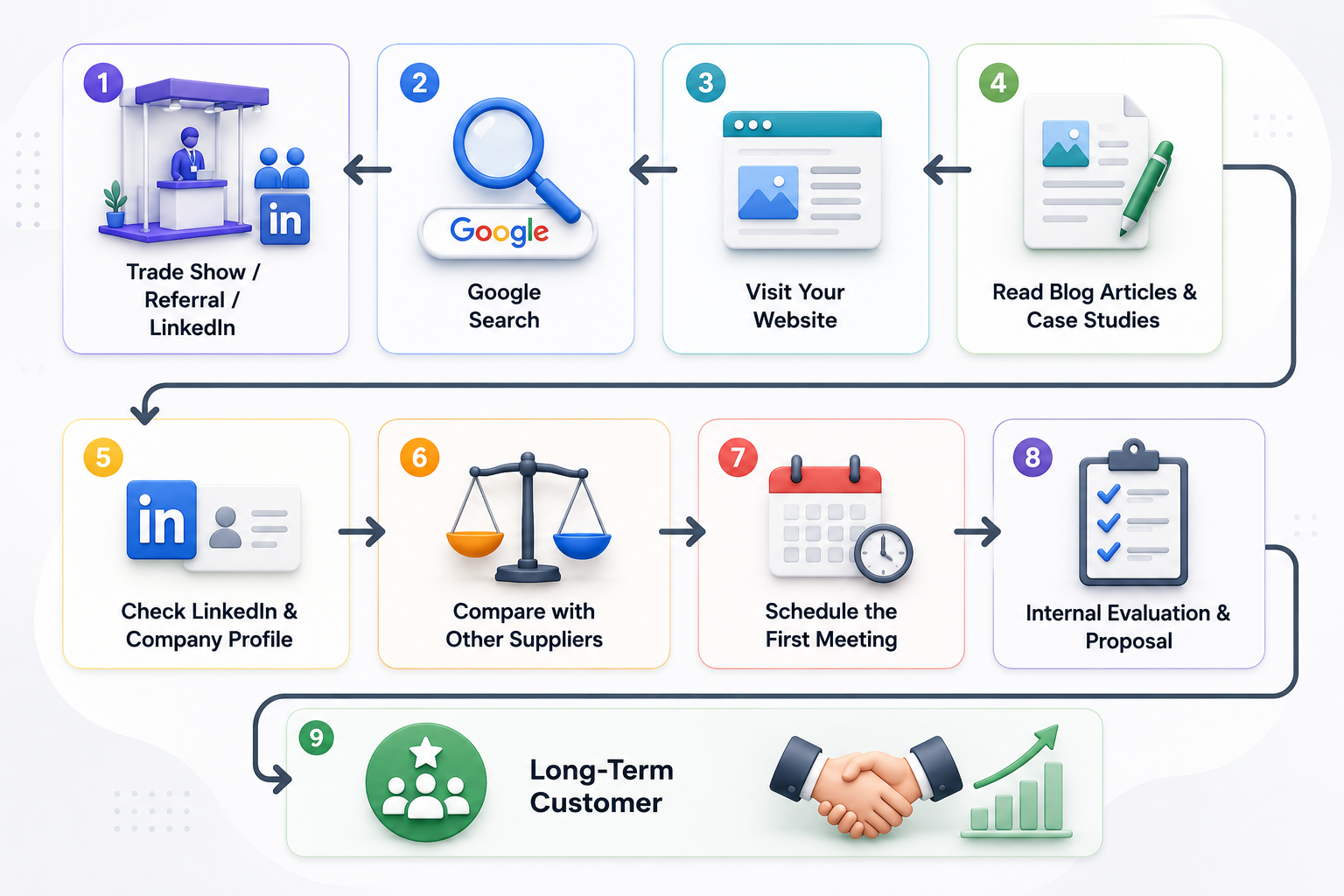
Although every buying journey is different, the pattern is remarkably similar. Before scheduling a meeting, Japanese decision-makers often move through several digital touchpoints to evaluate your business. Every stage is an opportunity to strengthen trust or lose it.
Visibility creates opportunities. Trust turns those opportunities into customers.
The companies achieving sustainable growth in Japan don't depend on one marketing channel.
They build an ecosystem where every touchpoint supports the next, making the decision to contact their business feel like the natural next step.
Google Ads services for B2B companies
One of the biggest mistakes foreign B2B companies make when entering Japan is focusing entirely on sales.
The thinking is understandable.
"We need more meetings."
"We need more demos."
"We need more customers."
But before any of those things can happen, something far more important has to happen first.
People need to know your company exists.
Many businesses invest heavily in outbound sales, attend exhibitions, purchase prospect lists, or hire business development representatives expecting enquiries to arrive immediately. A few promising conversations take place, business cards are exchanged, and everyone leaves feeling optimistic.
Then... nothing.
Emails go unanswered.
Follow-up messages receive no reply.
The opportunities that looked so promising quietly disappear.
In many cases, the problem wasn't your product.
It wasn't your pricing.
It wasn't your sales team.
The problem was that your prospects didn't know your business well enough to trust it.
Japanese B2B buyers rarely make important purchasing decisions after a single interaction. Familiarity develops over time. Every article they read, every Google search where your company appears, every LinkedIn post they see, and every case study they explore gradually reduces the perceived risk of doing business with you.
Companies rarely buy from businesses they've never heard of.
That's why marketing isn't simply about generating traffic.
It's about building familiarity before your prospects are ready to buy.
Imagine a company starts researching CRM software today but doesn't plan to invest until six months from now. If they consistently encounter your business throughout those six months through search results, educational content, LinkedIn, and industry insights—you won't feel like a stranger when they're finally ready to make a decision.
You'll feel familiar.
And familiarity builds trust.
The strongest B2B growth strategies don't rely on one campaign or one marketing channel.
They create a system where every interaction supports the next, making your company increasingly visible, increasingly credible, and increasingly trusted over time.
By the time a prospect finally contacts your business, the sales process has already begun.
In many cases, you've simply become the company they already wanted to speak with.
Expanding into Japan rarely fails because of a poor product.
More often, it struggles because companies assume the same strategy that helped them succeed elsewhere will produce the same results here.
If you're planning to enter the Japanese market, it's worth remembering one simple idea:
You're entering a new market not just a new country.
The expectations are different.
The buying journey is different.
The way businesses evaluate new suppliers is different.
Perhaps the most common mistake is expecting immediate results.
If you've successfully expanded into other international markets, you're probably familiar with seeing momentum within a few weeks or months. Japan often follows a different timeline. Relationships are built gradually, purchasing decisions involve multiple stakeholders, and businesses prefer reducing risk before making long-term commitments.
That doesn't mean growth is slower.
It means trust comes first.
Another common mistake is assuming your existing marketing can simply be copied and pasted into Japan.
The messaging that resonates with customers in the United States, Europe, or Australia won't always answer the questions Japanese decision-makers are asking. Buyers here often look beyond product features and pricing. They want confidence that your company understands their business, communicates professionally, and is committed to supporting them over the long term.
Many companies also rely too heavily on a single marketing channel.
Some invest everything in Google Ads while neglecting long-term SEO. Others attend trade shows but fail to create an online presence that supports the interest those events generate. Some depend entirely on referrals, assuming recommendations alone will consistently generate new opportunities.
Today's buyer journey is far more connected than that.
A referral often leads to a Google search.
That Google search leads to your website.
Your website leads to your case studies.
Your case studies lead to your LinkedIn profile.
Every interaction either increases confidence or creates uncertainty.
Your marketing is only as strong as your weakest touchpoint.
Perhaps the biggest mistake of all is believing marketing begins after you've entered Japan.
The companies that achieve sustainable growth usually start much earlier.
They build visibility before launching.
They publish valuable content before expecting enquiries.
They establish credibility before asking prospects to trust them.
By the time they're actively selling, they're no longer introducing themselves.
The market already knows who they are.
That's what separates businesses that constantly chase opportunities from those that consistently attract them.
Expanding into Japan isn't about finding one perfect marketing tactic.
It's about building a strategy where every activity supports the next, making it easier for potential customers to discover your business, understand your expertise, and confidently choose you over your competitors.
SEO strategy for businesses expanding into Japan
One of the biggest reasons foreign companies become discouraged when expanding into Japan is because they expect results too quickly.
That's completely understandable.
If you've successfully entered other international markets, you're probably used to seeing early traction within a few weeks or months. Japan, however, operates differently. Relationships take longer to establish, purchasing decisions involve more people, and trust is earned gradually rather than instantly.
That doesn't mean growth is slow.
It means growth follows a different rhythm.
Understanding that from the beginning will help you set realistic expectations and make smarter long-term decisions.
During your first few months, your priority shouldn't be closing as many deals as possible.
Instead, your focus should be on building a strong foundation.
That means identifying your ideal audience, publishing valuable content, improving your visibility through SEO, running targeted Google Ads campaigns, and creating the credibility Japanese buyers expect before they ever contact your business.
At this stage, enquiries may still be limited.
That's perfectly normal.
You're introducing your company to a market that has never heard of you before.
Between the third and sixth month, you'll usually begin noticing meaningful progress.
Your website attracts more qualified visitors.
Your content begins appearing in search results.
Google Ads provides valuable insights into which industries and keywords perform best.
More importantly, businesses begin recognising your brand instead of discovering it for the very first time.
This is often when the first qualified conversations begin.
Not every enquiry will become a customer immediately.
But you're building something even more valuable than short-term sales.
You're building trust.
As your visibility continues growing, every marketing activity starts reinforcing the next. Your content improves your SEO. Better SEO increases organic traffic. Google Ads continues generating immediate visibility while your organic presence becomes stronger. LinkedIn reinforces your credibility, and customer success stories provide the proof that helps buyers make confident decisions.
Instead of relying on one channel, your entire digital presence begins working together.
After a year of consistent effort, something changes.
You're no longer introducing your business to the market.
The market already knows who you are.
Prospects have discovered your company through Google, read your content, seen your LinkedIn presence, or heard about your business from existing customers and partners.
Sales conversations become much easier because you're no longer starting from zero.
The companies that achieve sustainable growth in Japan understand this.
They don't measure success week by week.
They measure it over the long term.
Because Japan rewards consistency far more than speed.
Successfully expanding into Japan isn't about choosing between SEO, Google Ads, LinkedIn, or content marketing.
It's about understanding how those channels work together to support the way Japanese businesses actually buy.
That's where Boostify comes in.
We're a bilingual digital marketing agency based in Tokyo, helping foreign B2B companies build sustainable growth in the Japanese market.
Rather than focusing on isolated marketing activities, we create integrated strategies designed around one objective:
Helping the right companies discover your business, trust your expertise, and become long-term customers.
Whether you're entering Japan for the first time or looking to accelerate your existing growth, we help you identify where your ideal customers are, how they research new suppliers, and what gives them the confidence to choose your business over your competitors.
From SEO and Google Ads to LinkedIn marketing, content marketing, and lead generation, every strategy we build is tailored to the Japanese market—not copied from another country.
Because successful expansion isn't about applying the same playbook everywhere.
It's about understanding what works in Japan and building a strategy around it.
If you're ready to grow your business in Japan, we'd love to learn more about your goals and explore how we can help you build a sustainable growth strategy for the Japanese market.
Every business is different, but most companies should expect to invest between six and twelve months before seeing consistent momentum. Building trust and brand recognition in Japan takes time, especially in B2B industries where purchasing decisions often involve multiple stakeholders. While some businesses generate early enquiries through Google Ads or referrals, sustainable growth usually comes from consistently building visibility and credibility over the long term.
Yes. Japan is one of the world's largest economies and is home to globally recognised businesses across manufacturing, technology, healthcare, finance, and professional services. Companies that understand the Japanese buying process and invest in building long-term relationships often find significant opportunities for sustainable growth.
Absolutely.
Most Japanese B2B buyers research potential suppliers online before making contact. A strong SEO strategy helps your business appear when decision-makers are actively searching for solutions, increasing both your visibility and credibility. While SEO requires patience, it continues generating qualified traffic long after your content has been published.
SEO strategy for businesses expanding into Japan
For many businesses, the most effective approach is combining both.
Google Ads helps you generate visibility and qualified leads immediately, while SEO builds long-term authority and organic traffic. Running both strategies together allows you to generate opportunities today while creating a sustainable source of leads for the future.
It depends on your target audience.
If you're selling primarily to Japanese businesses, a professionally localized Japanese website can significantly improve credibility and user experience. Simply translating your existing website isn't always enough. Localization ensures your messaging reflects the expectations and buying behaviour of Japanese decision-makers.
professional website for the Japanese market
Yes.
Many international companies successfully generate business in Japan without establishing a physical office immediately. However, when you don't yet have a local presence, your digital credibility becomes even more important. A professional online presence, valuable content, strong SEO, and consistent communication all help reduce uncertainty for potential customers.
Although LinkedIn has a smaller user base in Japan than in countries like the United States or the United Kingdom, it's widely used by professionals, executives, and decision-makers working within multinational companies. For international B2B businesses, LinkedIn is an excellent platform for building credibility, sharing expertise, and strengthening your overall digital presence.
One of the biggest mistakes is assuming the same strategy that worked in another country will produce the same results in Japan.
Japanese businesses evaluate suppliers differently. They often spend more time researching companies, involve multiple stakeholders in purchasing decisions, and place greater emphasis on trust before beginning a business relationship. Understanding these differences early can prevent costly marketing mistakes later.
The strongest lead generation strategies combine multiple channels rather than relying on a single tactic. SEO helps buyers discover your business organically, Google Ads generates immediate visibility, LinkedIn strengthens credibility, and valuable content builds trust over time. Together, these channels create a consistent flow of qualified opportunities.
Working with a marketing agency that understands both international businesses and the Japanese market can help you avoid common mistakes and adapt your strategy to local buying behaviour. Instead of applying a one-size-fits-all approach, a local partner can help you create campaigns that better align with how Japanese decision-makers research, evaluate, and choose suppliers.
Expanding into Japan doesn't have to be overwhelming, but it does require the right strategy.
The companies that achieve sustainable growth aren't necessarily the ones with the biggest marketing budgets or the most well-known brands. More often, they're the companies that understand how Japanese buyers make decisions, invest in building trust before asking for a sale, and create a long-term strategy tailored to the Japanese market.
At Boostify, we help foreign B2B companies do exactly that.
Whether you're entering Japan for the first time or looking to accelerate your existing growth, we work with you to build a digital marketing strategy that attracts the right audience, establishes credibility, and generates qualified business opportunities.
From SEO and Google Ads to LinkedIn marketing, content marketing, and lead generation, every strategy we create is designed around one goal:
Helping your business become the company Japanese buyers discover, trust, and choose.
If you're ready to build a stronger presence in Japan, we'd love to learn more about your business, understand your goals, and discuss how we can help you grow.
Ready to take the next step?
Schedule a free strategy consultation with Boostify and start building your growth strategy for Japan today.